


Welcome to CrowdSource, your weekly guided tour of the latest intellectual disputes, ideological disagreements and national debates that piqued our interest (or inflamed our passions). This week: was a war crime caught on tape?
Join us! CrowdSource features the best comments from The Crowd — our cherished readers and subscribers who, with their comments and emails, help make Wisdom of Crowds what it is.
Two Strikes
As we discussed on our latest podcast, Congress is investigating whether those involved in a September 2 bombing committed a crime in ordering a second strike, which killed two survivors of the first bombing.
The target of the bombing was a boat allegedly linked to narco-trafficking.
The Testimony. From the New York Times’ report on December 4:
When the smoke finally cleared about 30 minutes later, the front portion of the boat was overturned but still afloat, according to lawmakers and congressional staff who viewed the video or were briefed on it. Two survivors, shirtless, clung to the hull, tried unsuccessfully to flip it back over, then climbed on it and slipped off into the water, over and over.
Then Adm. Frank M. Bradley, commander of the operation, gave an order for a follow-up strike. Three flashes of light filled the video screen. And the men were gone.
From ABC’s report:
[The men] were believed to be potentially in communication with other boats in the vicinity and were salvaging some of the drugs that had been the boat’s cargo, the source said.
Because of these actions, the two survivors were determined to be “still in the fight” and considered to be valid targets.
The Story Emerges. It’s also been reported that two survivors were “waving” after the first bombing, and that there’s no evidence that they were radioing for backup.
Video Evidence. President Donald Trump himself posted the video:
Was It A War Crime?
Probably.
The Second Strike. In a New York Times essay, novelist and Marine Corps veteran Phil Klay lists the reasons why the second strike might have been a war crime:
The Geneva Conventions say shipwrecked persons must be “respected and protected.” The Department of Defense Law of War Manual states that helpless, shipwrecked survivors are not lawful targets, while The Hague regulations forbid orders declaring that no quarter will be given.
“Clearly Unlawful,” says Michael N. Schmitt, former Air Force lawyer and professor emeritus at that Naval War College:
I can’t imagine anyone, no matter what the circumstance, believing it is appropriate to kill people who are clinging to a boat in the water. … That is clearly unlawful.
The First Strike. Rutgers law professor Adil Haque points out that the first strike, too, could be deemed illegal:
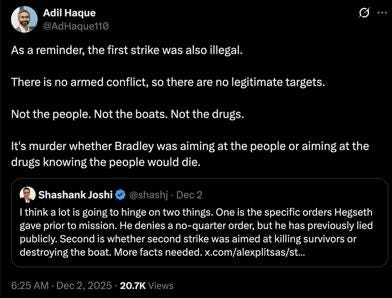
Awful, But Lawful. Professor Peter Feaver of Duke University tells franknews that, overall, the strikes by the US military on the (alleged) narco-trafficking boats have been lawful:
They’re probably lawful. Some may be awful, but they’re probably lawful. […] so far, the courts have not intervened on the Venezuela strikes. They probably won’t. There have been some lower court halts on the deployment to Chicago and Portland, but most people expect that will be overturned once it gets to SCOTUS.
“Obligations of Accountability.” New York University law professor (and former White House counsel to Barack Obama) Bob Bauer writes that the boat strike puts to the test Trump’s understanding of the scope of his power:
This president, like others before him, appeals to his election as a mandate for his actions, but Trump takes it further. He appeals to his election as continuing proof of public support for whatever he decides to do and as sufficient basis to relieve him of other obligations of accountability. […] The president has avowed that it is “good to have a strongman at the head of a country” and it is reasonable to understand from Trump’s repeated references to the size and historical nature of his election victories that these are, for him, the foundation of his claim to exercise sweeping powers.
“Lose a Limb and Bleed Out.” Lawyer Megyn Kelly (JD, Albany Law School) says:
I really do kind of not only wanna see them killed in the water, whether they’re on the boat or in the water, but I’d really like to see them suffer. I would like Trump and Hegseth to make it last a long time so they lose a limb and bleed out.
Was It Barbarism?
Commentary beyond the legal question.
Delighting in Violence. In that same opinion essay, Phil Klay argues that there’s something more irrational and bloodthirsty at play in the boat strikes:
… In lieu of careful analysis of the campaign’s legality, detailed rationales for the boat strikes and explanations of why they couldn’t be done with more traditional methods, we get Mr. Hegseth posting an image of himself with laser eyes and video after video of alleged drug traffickers being killed. … I suspect the question the administration cares about is not “is this legal,” “is this a war crime,” “is this murder” or even “is this good for America,” but rather, “isn’t this violence delightful?”
The Legal Question is Beside the Point, says Jason Willick of the Washington Post:
… legalism risks becoming the focus of this scandal. But it’s beside the point: Nobody is going to be criminally prosecuted. The legal advice the military acted on probably confers a measure of immunity, and President Donald Trump can pardon those involved anyway. […] The second strike might be subject to a unique legal analysis, but the notion that the president has inherent constitutional powers to summarily kill people he suspects of trafficking cocaine is bankrupt to begin with. …
Surrender and Mercy. Writes Hillsdale dean and professor of government Matthew Mehan:
As it turns out, in person and up-close combat, while much more dangerous, does have more options for surrender and mercy than, say, long range naval engagements or eye in the sky drone strikes.
Bloody-Minded Utilitarianism. Ross Douthat says that the Administration is acting at odds with its self-professed Christianity:
I don’t want to say that a policy of direct attacks on drug cartels is inherently inconsistent with Christian ideas about just war; perhaps a case could be made and a strategy constructed that clarifies when exactly a drug mule becomes a combatant. […] But I do not hear such a case from Hegseth or the administration. The argument instead is mostly a bloody-minded utilitarianism: Bad guys being killed saves American lives; you can trust us that these are all bad guys; no, you can’t see the legal justification; and anyway, Obama killed more people with his drone strikes.
Words and Pictures
Some meta-perspective provided by theory and fiction.
“The Paradox of Hypocrisy.” Apropos all of the above, some words from our own Shadi Hamid’s new book, The Case for American Power:
Far from being a mere flaw, hypocrisy is the crucible in which ideals and reality collide. It is through this tension that societies grapple with their aspirations, confront their shortcomings, and inch toward the values they profess but fail to full embody. This is the paradox of hypocrisy. The gap between the rhetoric and action serves as constant reminder of our unfulfilled commitments.
“Ten Kliks South.” A poignant tale from Phil Klay’s short story collection, Redeployment:
So there’s no indication here of what happened, though I know ten kliks south of us is a cratered area riddled with shrapnel and ruined buildings, burned-out vehicles and twisted corpses. The bodies. Sergeant Deetz had seen them on his first deployment, during the initial invasion. None of the rest of us have.
I turn sharply away from the gun line. It’s too pristine. And maybe this is the wrong way to think about it. Somewhere, there’s a corpse lying out, bleaching in the sun. Before it was a corpse, it was a man who lived and breathed and maybe murdered and maybe tortured, the kind of man I’d always wanted to kill. Whatever the case, a man definitely dead.

From the Crowd
Danger is a theme in this week’s comments — dangerous incentives in the defense industry, as well as a strange, personal longing for danger.
“Moonshot Category.” Responding to our dialogue with Connor Echols (“What does Palantir Believe In?”), AI engineer Neural Foundry argues that venture capital has incentivized the creation of autonomous weapons:
Incredible piece here. Echols nails the real tension when he brings up the security dilemma and how dominance-seeking backfires into arms spirals. The Cold War nuclear treaties remind us that strategic restraint can actually build more durable security than raw force expansion. But here’s the rub: venture capital has basically discovered defense as a moonshot category, which means these emergent autonomous weapons systems are more about market timing than strategic coherence. The incentives are all wrong for the kind of discernment we need.
“Longing for Excitement.” Wisdom of Crowds contributor Sam Mace muses on Damir Marusic’s report from Ukraine:
… It strikes me that perhaps people long for the excitement that they find in difference — be that a new partner, a new environment, or, in your case, which is not historically uncommon, a lust for seeing the world and even conflict. When I read the news of the US situation, it strikes me that perhaps both sides somewhat wish they were part of a revolutionary, almost titanic struggle to the death ... Of course, as you’ve written, for the vast majority, they live their lives as normally as possible even during the most turbulent of eras.
See you next week!
Wisdom of Crowds is a platform challenging premises and understanding first principles on politics and culture. Join us!
"the notion that the president has inherent constitutional powers to summarily kill people he suspects of trafficking cocaine is bankrupt to begin with"
This seems like the heart of the matter. Is it true? I'd say it's obviously true. First, you can't simply kill people you suspect are committing a crime; you have to apprehend them and then prove their guilt. Second, you can't kill noncombatants, period. Third, it's not a war unless Congress says so, every sixty days, or else definitely declares war. Quite apart from the disgusting slaughter of the two survivors of the first strike, the whole enterprise is squalid, depraved, and quintessentially Trumpian.