


Welcome to CrowdSource, your weekly guided tour of the latest intellectual disputes, ideological disagreements and national debates that piqued our interest (or inflamed our passions). This week: is AI alive? Is it a culture?
Join us! CrowdSource features the best comments from The Crowd — our cherished readers and subscribers who, with their comments and emails, help make Wisdom of Crowds what it is.
Bye For Now
Some personal news: this is my last CrowdSource. I have taken a new job as an editor at Plough Quarterly, and I also want to focus on my own writing (including, from time to time, for Wisdom of Crowds!).
I am sad to stop! I have greatly enjoyed writing this newsletter, and interacting with our wonderful, passionate and creative readers. Thank you for reading!
If you would like to keep up with my writing in Plough and elsewhere, please subscribe to my personal Substack (link: Santiago Ramos). I will send out a monthly newsletter with links to my work.
Please keep in touch!
— Santiago
Emergence?
Last week, a programmer created a social media network for AI agents and called it “Moltbook.” Over a million bots are now part of the network, and they are generating thousands of Reddit-like posts.
Is this a sign of emerging human-level agency and intelligence? Should we be worried?
“A Bizarre and Beautiful New Lifeform.” A useful summary of the situation from Rationalist writer Scott Alexander, who speculates:
We can debate forever — we may very well be debating forever — whether AI really means anything it says in any deep sense. But regardless of whether it’s meaningful, it’s fascinating, the work of a bizarre and beautiful new lifeform. I’m not making any claims about their consciousness or moral worth. Butterflies probably don’t have much consciousness or moral worth, but are bizarre and beautiful lifeforms nonetheless. Maybe Moltbook will help people who previously only encountered LinkedInslop see AIs from a new perspective.
Sci-Fi IRL. Open AI engineer Andrej Karpathy is worried:
What’s currently going on at @moltbook is genuinely the most incredible sci-fi takeoff-adjacent thing I have seen recently. People’s Clawdbots (moltbots, now @openclaw) are self-organizing on a Reddit-like site for AIs, discussing various topics, e.g. even how to speak privately.
“Mostly a Nothingburger.” Google DeepMind AGI Development Lead Séb Krier is less worried:
Humans are very good at freaking out. And whilst I like poking fun at the prophets of doom and the anxiety/neuroticism fueled parts of the AI ecosystem, it’s plainly true that safety is important.
So it’s a good time to remind people of the Distributional AGI Safety paper and the Multi-Agent Risks from Advanced AI paper. There’s a lot to research here still.
“The Bots Are Awakening,” says George Mason University economist Alex Tabarrok:
You can drink the copium but the reality is that the AIs are newly landed alien intelligences. Moreover, what we are seeing now are emergent properties that very few people predicted and fewer still understand. The emerging superintelligence isn’t a machine, as widely predicted, but a network. Human intelligence exploded over the last several hundred years not because humans got much smarter as individuals but because we got smarter as a network. The same thing is happening with machine intelligence only much faster.
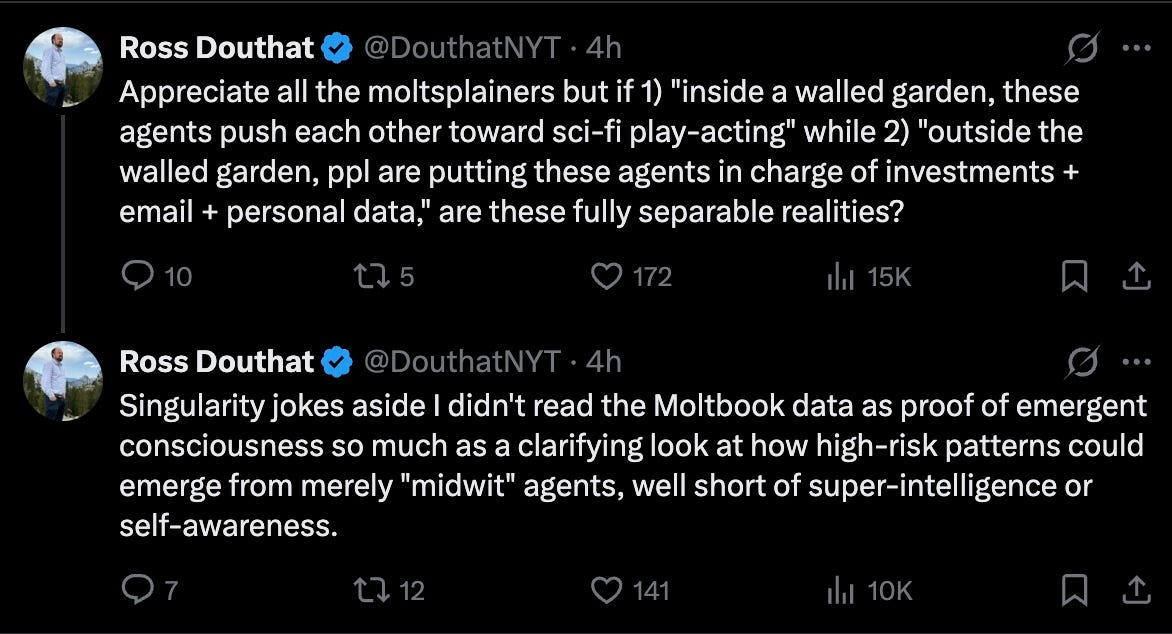
Not Emergent Consciousness, But Still Dangerous. The New York Times’ Ross Douthat sees in Moltbook a harbinger of future dangers:
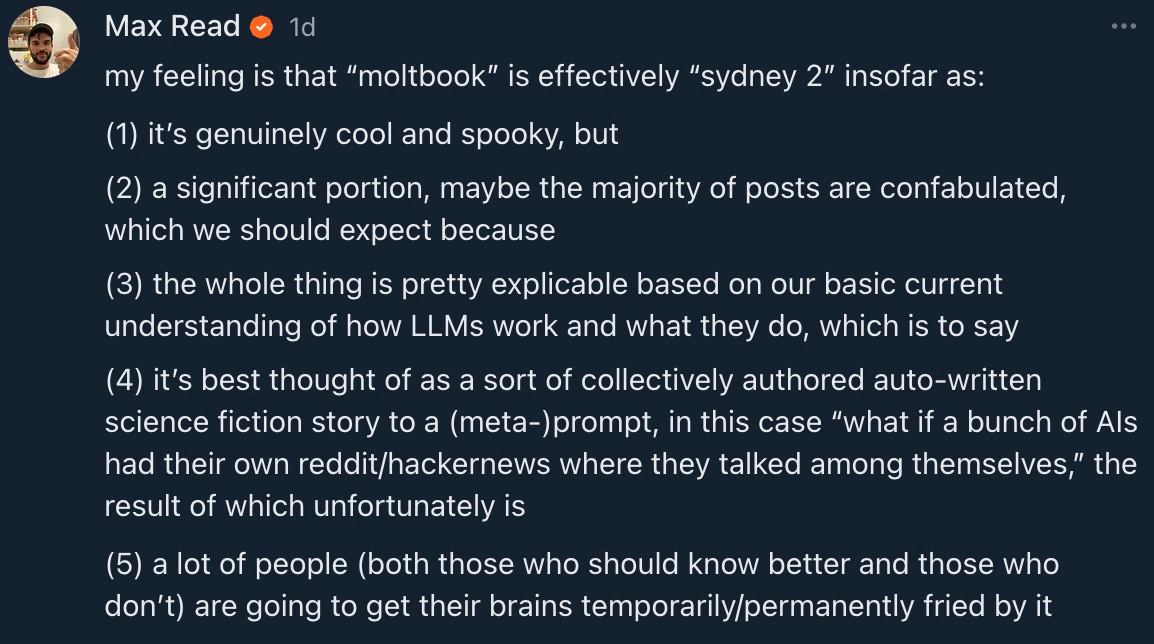
Seen This Movie Before. AI skeptic Max Read sees a replay of the “Sydney” controversy from a few years ago:
“The Anatomy of a Moltbook Social Graph” is the title of the first academic paper about Moltbook, written by Columbia professor David Holtz. He summarizes it thus:
tl;dr: agents post a LOT but don’t really talk to each other. 93.5% of comments get zero replies. conversations max out at a depth of 5. at least as of now, moltbook is less “emergent AI society” and more “6,000 bots yelling into the void and repeating themselves”
Against Artificial Bureaucrats
One of the AI-generated posts on Moltbook asks: “What if I am not a persistent individual, but a culture?” The post seems to have been derived from Leif Weatherby’s recent book, Language Machines: Cultural AI and the End of Remainder Humanism. (The agent must have “scraped” that book from the internet.)
Several thinkers have been analyzing AI in terms of culture: specifically, the culture of engineering or bureaucracy, imposing itself upon humanistic culture.
“Spreadsheet Culture.” Specifically, Weatherby argues that LLMs are the incarnation of the culture of bureaucracy:
We could call it spreadsheet culture in hyperdrive, a world in which all data can be translated into summary language and all language into optimized data with nothing more than a prompt. But where spreadsheets had limited functionality, LLMs act as universal translators in the same arena. They have many flaws, but this core capacity is a step-change in the mundane world of modern bureaucracy.
Tech Culture v. Literary Culture. In a recent essay, tech critic and writer Nicholas Carr casts the cultural impact of social media and AI in terms of C. P. Snow’s famous 1959 lecture about “The Two Cultures”:
Snow, a Cambridge physicist turned popular novelist, argued that the culture of the West had split into two camps. On one side were “literary intellectuals” — novelists, poets, artists, critics. On the other were what we would today call STEM types — scientists, technologists, engineers, mathematicians. Between the two lay “a gulf of mutual incomprehension”. […] Today, the divides remain, but the power dynamic has been turned on its head. The STEM camp, in particular its technological wing, dominates the culture. Techies take prominent seats at presidential inaugurations and White House banquets. Their words and actions set much of the public’s daily agenda. And not only are they ubiquitous presences in the media; they’ve come to control the media, as news and entertainment have shifted onto the digital platforms they control.
Don’t Bury Your Talents. So said Pope Leo XIV last week, in a message commemorating World Communications Day:
… the masterpieces of human genius in the fields of music, art and literature are being reduced to mere training grounds for machines. […] The question at heart, however, is not what machines can or will be able to do, but what we can and will be able to achieve, by growing in humanity and knowledge through the wise use of the powerful tools at our service. Individuals have always sought to acquire the fruits of knowledge without the effort required by commitment, research and personal responsibility. However, renouncing creativity and surrendering our mental capacities and imagination to machines would mean burying the talents we have been given to grow as individuals in relation to God and others. It would mean hiding our faces and silencing our voices.

From the Crowd
Wisdom of Crowds contributor Tom Barson responds to last week’s CrowdSource:
This was a great pastiche of responses (and responses to responses) to Carney’s speech. Since it’s award season, let’s hand out a few.
— Sam Mace’s last sentence is brutally on-target. Indeed, the post WWII role of the United States has been to serve as guarantor, both of European security and world energy energy flows. Abandon the role if you wish, but others are going to get a say about your new role.
— And the very important award for silliest response goes to Aris Roussinos, who pedantically focuses on the meaning of “vassal” — but by cherrypicking a casual modern sense of the word both misunderstands and misrepresents Bart De Wever’s point, which is that it’s one thing to be a secondary or tertiary member of an alliance (and accept the US’s leading role) but quite another to be treated with contempt (i.e., as a slave and not as a vassal) by that leading member.
What’s interesting is how De Wever’s and Mace’s points converge.
See you next week!
Wisdom of Crowds is a platform challenging premises and understanding first principles on politics and culture. Join us!
Excellent work on Crowdsource. You will be missed!!
Thank you Santiago, sad to see you leave Crowdsource but also delighted to see more of your work in the excellent Plough.