


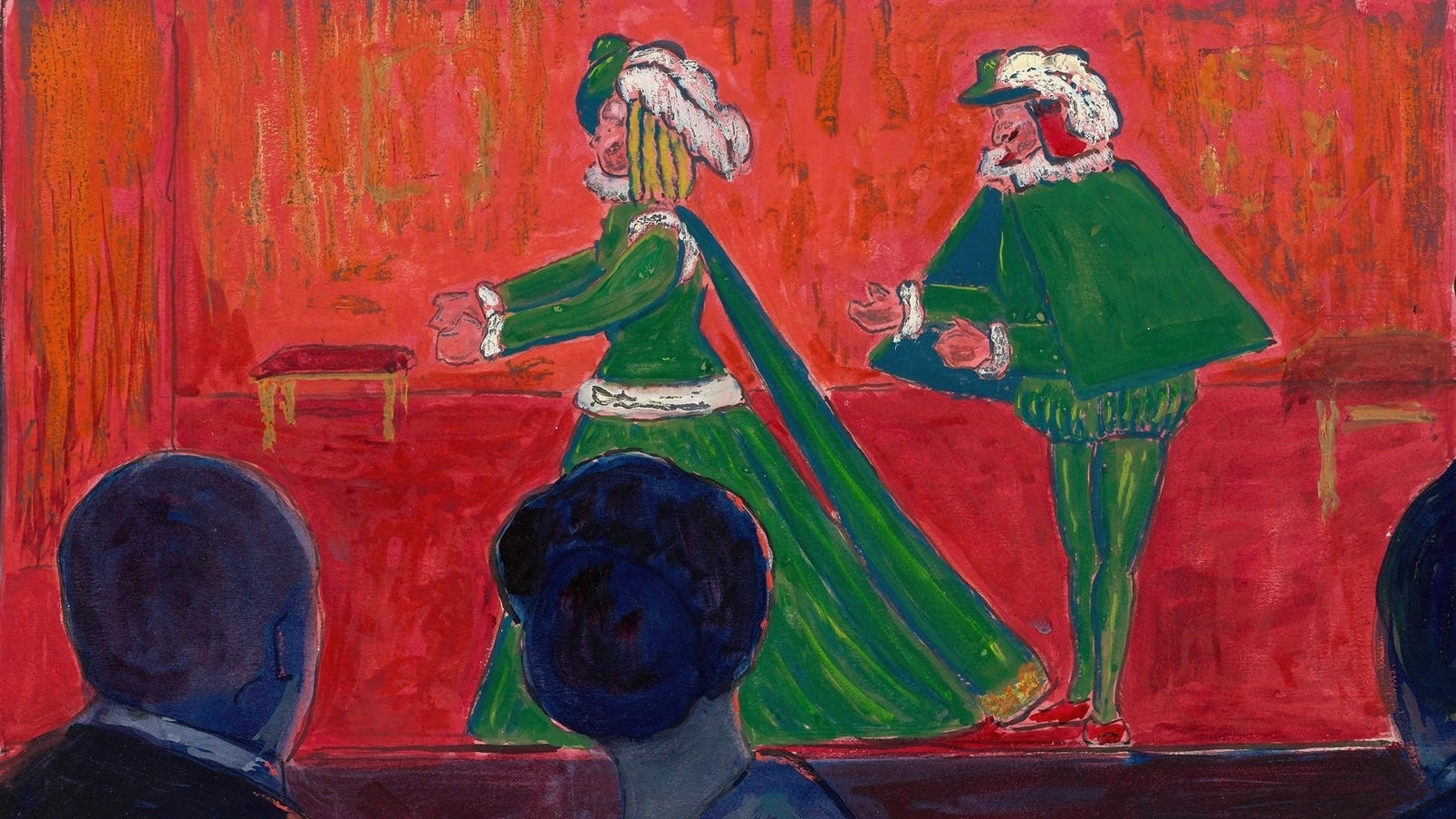
Cultural institutions — including this one — are getting into event planning. It’s about more than just public readings. It’s a trend toward in-person gatherings instead of virtual meetups. People want to be around other people; they want to meet new people; they want an excuse to get out. We asked Wisdom of Crowds contributor Matthew Gasda whether he’s noticed the same thing. It turns out that Gasda, who spends most of his time putting on plays and organizing public readings, has a lot to say about the topic.
— Santiago Ramos
The boom in literary readings, plays, happenings, branded parties, and debates — of which, for better or worse, I’ve participated in and organized — signals that communication deeply matters to us as a species and culture. But it’s also a sign that online communication has altered our ability to communicate, and therefore how we organize social experience. Having been closer to the center than the periphery of New York underground theater and literary culture during the last five years, I feel justified in making the following Sean Monahan-style trend forecast for 2026: live events will gain popularity in direct proportion to the decline of functional literacy; writers will write less for the page and more for the ear; readers will become, functionally and spiritually, listeners, viewers, collective-absorbers, reliant on cues provided by crowds.
This is not a trivial trend. The shift away from the visual toward the oral and aural is both symptom and cause, a marker of cognitive transformation and a driver of further behavioral modification. The movement from text-based to televisual decoding has been underway for generations. Dana Gioia wrote more than twenty years ago: “We are currently living in the midst of a massive cultural revolution. For the first time since the development of movable type in the late fifteenth century, print has lost its primacy in communication.” In 1984, Neil Postman correctly understood that the long, humanistic “habits of mind” that began with Erasmus — which required “considerable powers of classifying, inference-making, and reasoning … to detect abuses of logic and common sense” — were rapidly eroding. Before Postman, Marshall McLuhan articulated a still-useful theory about the relationship between medium and message, between cognition and televisual stimulation.
The trend has now reached critical mass. Our generalized inability to maintain eye contact, pay attention, write letters, read books, sit through movies without checking our phones has produced guilt, anxiety and a reasonable fear that we have lost access to one of the great inheritances of liberal modernity: the headstrong, clearly articulated word which binds us together across space and time.
The age of the printed word was one in which written language made people feel closer together. I’ve been reading Samuel Richardson’s epistolary novel Clarissa, nearly 350 years old, and I am astounded at the eloquence, force, and lexical dexterity of every character who writes a letter. This was considered realistic! And Saul Bellow’s Herzog from the 1960s shows us this world at its zenith and the beginning of its decline — Herzog neurotically writing letters to himself and to the great humanists and philosophers. Even in the early 2010s, when I was in college, I could reasonably find half a dozen correspondents a year. I kept a diary by hand. Now it feels harder — feels harder internally, like my brain has changed, or been changed. It is harder to sustain a conversation in writing.
David Foster Wallace’s long digital letters from the nineties show that the internet hadn’t killed but had temporarily accelerated the power of the word, even as it gathered the force to kill it. Like a star exploding at the end of its life cycle, the internet produced more written words than ever by many orders of magnitude, even while their effectiveness declined. In the 2000s and 2010s, you can see how the visual layout of text on a Blogspot, a Tumblr, a webpage like Vice or Gawker influenced how people wrote, how people thought. That was the terminal stage of the Gutenberg galaxy.
The 2020s feel different. I know this both as a playwright and live reader of prose fiction. All the nonverbal cues, the biomechanical and chemical signals people share in a room — as well as the actors and director—help interpret and digest the text of a play and render it more communicative. In 1885, Ibsen published his plays before they were performed, because European Victorian culture — shy, ultra-bookish, ultra-literate, repressed — couldn’t handle the physical rendering until the text had been digested by reading first. I surmise we’re living through an inverted Victorian age, in which people — because of videos, pop psychology, the sheer amount of information they can internalize about the human face — are more socially literate, less verbally literate.
The brain changes, and social organization changes with it. The lust for the live event is not just a plea to end technologically enforced alienation; it reflects a structural desire for experiences that suit the dominant mode of cognition, which now requires multi-level visual and auditory stimulation to process text. Susan Sontag’s canonical description of the happenings of the 1960s sounds like a description of internet content: “The Happening operates by creating an asymmetrical network of surprises, without climax or consummation; this is the logic of dreams rather than the logic of most art.” The happening-like reading, the reading-centric happening, the happening-like play — readers known and unknown, musicians, coke fiends, it girls and boys; poems, autofiction, novel fragments, spoken word — are internet-like in their mode. Familiar, but less alienating than the internet itself. This points toward a telos for all this cognitive evolution: real spaces with an unreal, internet-derived aura.
A room full of people feels safer than a quiet night before a fire with a book. More comfortable. More interpretable. The rise of the reading series, the play, the debate, the live oracular event represents not just a meaningful reaction to post-Covid loneliness and social media fatigue, but a structural cognitive shift in which we hunger to understand what things mean, and to share those meanings with others. We want to feel the same way other people feel about something, to escape the extreme relativity of the internet, where for every opinion there’s some counter-voice inverting whatever knowledge is constructed.
The screen killed the book — not as an artifact, but as the ordering principle of the mind, of cognition. The TV weakened its hold. The computer and smartphone finished the job. But the smartphone’s cognitive dominance, like Macbeth’s reign over Scotland, is short-lived and productive of resentment. We would like to see it end as fast as it began. But we cannot fully return to the book because of the damage done to our brains. And so we are left with something more primitive than the book: the room, the campfire, and the story told around it.
Wisdom of Crowds is a platform challenging premises and understanding first principles on politics and culture. Join us!

As an author who does readings, I found this analysis quite true.
These live events—all have at their base the fact that someone has created, most likely written, an artifact to be shared. A lecture, a play, a music performance, all presume an audience and invite responses. The impulse to move away from the isolation and solipsism of the recent virtual digital life looks to me like it will veer toward the literal Platonic ideal— the Socratic conversions presented in the dialogues of Plato. True culture and intellection has always been a limited affair, even in the fading Athens of Socrates, Plato, and Aristotle. The more popular entertainments of Aristophanes and the other playwrights reflected those higher conversations. Reading circles, poetry readings, music performances, and lectures need to be kept alive in order to have anything to build on in the after times. After the destructive wave of AI as the final digital solvent of all things human and humane recedes people will need access to the record and tradition of real thought and culture. Just like the recovery of Plato and Aristotle in the middles ages, after the last dark age catastrophe