


Welcome to CrowdSource, your weekly guided tour of the latest intellectual disputes, ideological disagreements and national debates that piqued our interest (or inflamed our passions). This week: a protestor dies in Minnesota.
Join us! CrowdSource features the best comments from The Crowd — our cherished readers and subscribers who, with their comments and emails, help make Wisdom of Crowds what it is.
“Agents Firing At or Into Vehicles”
An ICE officer shot and killed a protestor, Renee Nicole Good, in her car. ICE claims that the officer shot in self defense. Everyone is arguing about the various videos showing what happened.
A sampling of reactions:
Recent Uptick in ICE Shooting Civilians. The Wall Street Journal has
identified 13 instances of agents firing at or into civilian vehicles since July, leaving at least eight people shot with two confirmed dead. According to court records and lawyers, only one civilian was armed—with a concealed weapon that was never drawn—and at least five of those shot were U.S. citizens. Several federal officers reported injuries, including bruised ribs, a dislocated finger and a bite wound.
ICE is Running Amok, argues Noah Smith:
Here’s a video of ICE agents in Arkansas beating up an unarmed U.S. citizen. Here’s a video of ICE agents arresting two U.S. citizens in a Target. Here’s a story about a similar arrest. Here’s a video of an ICE agent brandishing a gun in the face of a protester. Here’s the story of ICE agents arresting a pastor who complained about an arrest he saw. Here’s a video of ICE agents arresting an American citizen and punching him repeatedly. Here’s a video of ICE agents threatening a bystander who complained about their reckless driving. Here’s a video of ICE agents arresting a man for yelling at them from his own front porch. Here’s a video of ICE agents making a particularly brutal arrest while pointing their weapons at unarmed civilians nearby. Here’s a story about another ICE killing, this one in Maryland, under dubious circumstances.
There Is An Institutional Bias Against Using Deadly Force, and the ICE Officer Ignored It. Sam Kahn notes:
There is also very little in DHS guidelines to justify the actions of the officer. DHS’ department policy on the use of force holds that “Deadly force shall not be used solely to prevent the escape of a fleeing subject,” while stipulating that “deadly force is authorized to prevent the escape of a fleeing subject where the LEO [law enforcement officer] has a reasonable belief that the subject poses a significant threat of death or serious physical harm to the LEO or others and such force is necessary to prevent escape” — a circumstance that it would be a real stretch to apply here, especially to the officer’s second and third shots.
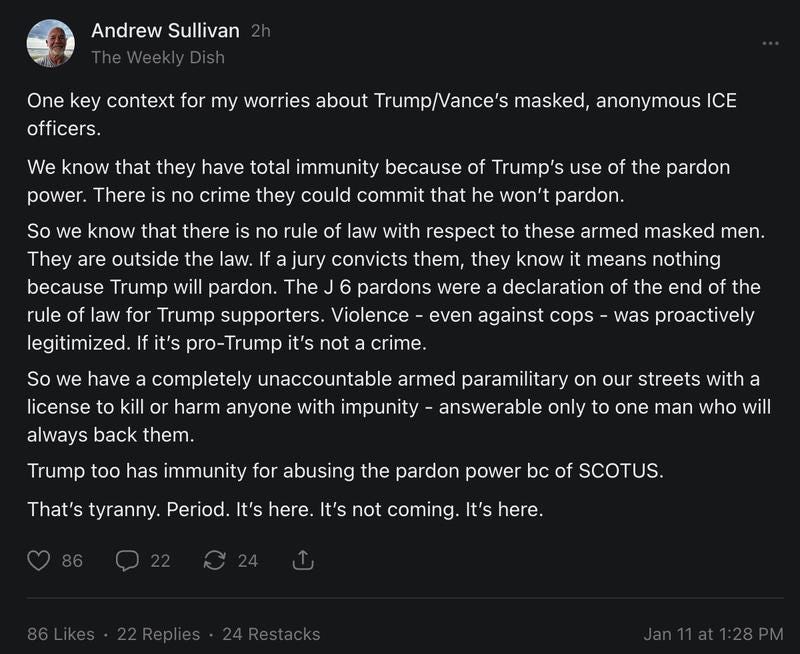
Tyranny Is Here. Says Andrew Sullivan:
ICE Watch. National Review’s Haley Strack on the pro-immigrant activist groups operating in Minnesota:
ICE Watch chapters, which have cropped up in communities across the country in recent years, train activists to monitor ICE activity using purpose-built apps and alert allies who have been trained to flood an operation area and interfere with arrests being made.
“A Tragedy, But a Justified Use of Force.” So argues legal commentator Andrew C. McCarthy:
Legally, what matters is whether the ICE agent who shot Good was in reasonable fear of death or serious injury in the moment that he shot. His state of mind must be assessed in light of all the surrounding circumstances as he perceived them — which excludes things about Good (positive or negative) that he did not know. Moreover, the evaluation is what a reasonable law enforcement officer would have perceived — that’s different from a reasonable person because law enforcement officers deal with life-and-death situations and, consequently, observe things that might escape other people’s attention.
… I find the endless lies and lying often to be the most infuriating and demoralizing part of the present situation. In the wake of this terrible killing in Minneapolis, my first thought, after the initial shock, anger, and sadness, was the knowledge that the next few days, months, weeks, and years would be filled with endless lying about what happened from the regime and its stooges. This filled me, if not quite with despair, then at least with a strong sense of depression. I suppose it has something to do with my vocation as a historian, where I can accept tragedy and even evil as unavoidable parts of the human experience, so long as witness can be borne and the truth eventually discovered.
The Conditions of Discernment. Musa al-Gharbi writes:
We’re unlikely to reach agreement about what these videos show because what stakeholders are ultimately arguing about isn’t what happened to Renee Good, specifically. We’re arguing about whether President Trump’s immigration crackdown is necessary, legal, or being carried out well. We’re arguing about the proper relationship of law enforcement to the publics they serve. We’re arguing about how to manage tradeoffs between goods like liberty and order. More fundamentally, we’re arguing about violence, coercion and expropriation: Who gets to enact these, against whom, under what conditions, and towards which ends. The best picture we have from the cognitive and behavioral sciences is that it would probably be more honest, productive and revelatory to talk about these “big” questions that ultimately drive differing interpretations of what happened on that Minnesota street than to quibble ad infinitum over different videos and what they reveal (or don’t).

From the Crowd
“You Can’t Really Divorce the Practical From the Moral.” Reader Ad Jones responds to Shadi Hamid and Damir Marusic on the subject of Venezuela:
[…] Damir says he would prefer that the US hadn’t gotten involved in Venezuela from a purely pragmatic perspective as opposed to a moral one. But what is he pragmatically aiming toward? What is the end that dictates the means? If it’s the greatest good for American people, now we’re dealing in ethics. Any ethics worth practicing is one that practically impacts wellbeing and differences in opinion usually come down to a question of who’s wellbeing. Obviously nothing stays the same and so we’re constantly having to judge whether we should be prioritising surviving or thriving. That constant dance is why ethics is never settled. But you can’t really divorce the practical from the moral can you? […]
Read the whole thing.
Honesty Doesn’t Cut It. Reader STUART SCADRON-WATTLES responds to Shadi Hamid’s essay, “Venezuela and the End of Hypocrisy”:
You don’t have to respect the honesty of this Regime, because they are being inhuman. It’s not about democracy, it’s about self-determination. This Regime replaced a weak wannabe with an overwhelmingly armed actual dictator, who openly admitted that he was looking for an in-country puppet to do his bidding. Honesty in pursuit of inhuman goals is STILL inhuman.
See you next week!
Wisdom of Crowds is a platform challenging premises and understanding first principles on politics and culture. Join us!
The bloodshed associated with immigration enforcement is entirely due to TDS and illegal immigrant obstruction of justice and resisting arrest.