


Welcome to CrowdSource, your weekly guided tour of the latest intellectual disputes, ideological disagreements and national debates that piqued our interest (or inflamed our passions). This week: war in Venezuela.
Join us! CrowdSource features the best comments from The Crowd — our cherished readers and subscribers who, with their comments and emails, help make Wisdom of Crowds what it is.
Why Are We In Venezuela?
The reasons given:
Drugs. Namely, cocaine and fentanyl. So argues Vice President J.D. Vance.
Iran and Hezbollah Are In Venezuela. So says Secretary of State Marco Rubio.
We Want the Oil, says President Trump.
A few reality checks:
Maduro Sealed His Own Fate. According to Compact’s Juan David Rojas:
… those who continue to cling to Maduro as an “anti-imperialist” martyr would do well to recognize the catastrophic damage he and close allies like Nicaragua’s Daniel Ortega have done for the left’s electoral prospects in the region. Hard as it may be for them to comprehend, the Orwellian logic of Maduro’s “anti-imperialist” imperialism is, in the eyes of voters, scarcely different from Trump’s naked pursuit of plunder.
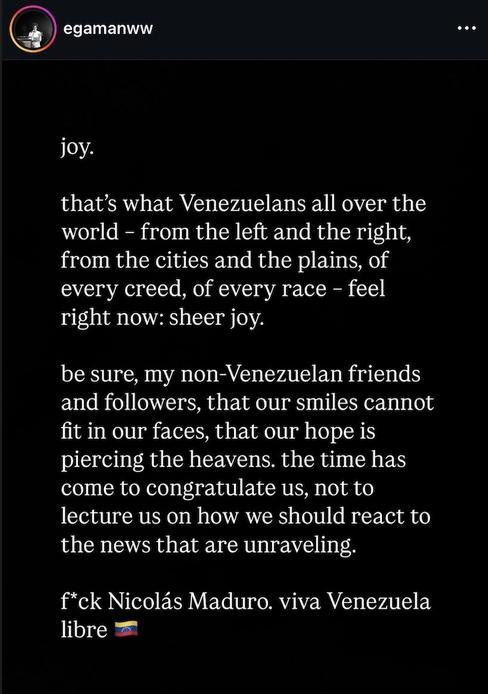
Most Venezuelans Are Glad Maduro Is Gone. Says Venezuelan writer and exile, Carlos Egaña:
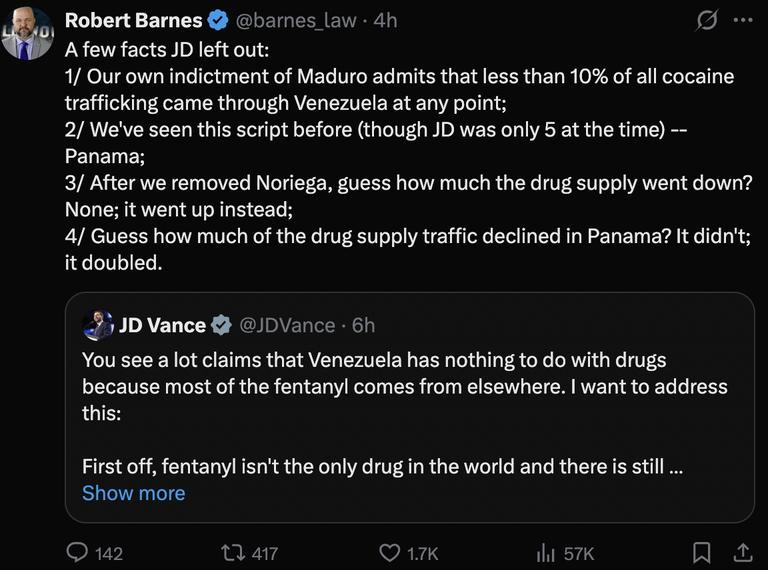
Drugs Trafficking Is A Bogus Reason To Go To War With Venezuela. According to trial lawyer, Robert Barnes, Vance’s argument about drugs is misleading:
Trump “Is Remaking the Hemisphere to Fit American Interests,” writes The New Statesman’s US correspondent, Freddie Hayward:
Maduro’s seizure might look like piratical chaos … But you can see the faint outline of a strategy through the carnage. What Steve Bannon once described to me as hemispheric defense means that Russian and Chinese influence in the region must be purged. As Sky’s Ed Conway has also pointed out, US oil refineries need Venezuela’s heavy oil, which they cannot get from their shale reserves. At the same time, the White House’s alliance with Javier Milei in Argentina and Nayeb Bukele in El Salvador show that Trump wants leaders in his own backyard who think and govern in his image.
Unfortunately, What Trump Did Was Legal. At least according to American law, writes Harvard Law professor Jack Goldsmith:
As I wrote in connection with the Soleimani strike: “our country has—through presidential aggrandizement accompanied by congressional authorization, delegation, and acquiescence—given one person, the president, a sprawling military and enormous discretion to use it in ways that can easily lead to a massive war. That is our system: One person decides.”
This is not the system the framers had in mind, and it is a dangerous system for all the reasons the framers worried about. But that is where we are—and indeed, it is where we have been for a while.
Two Hundred Years of Justifications
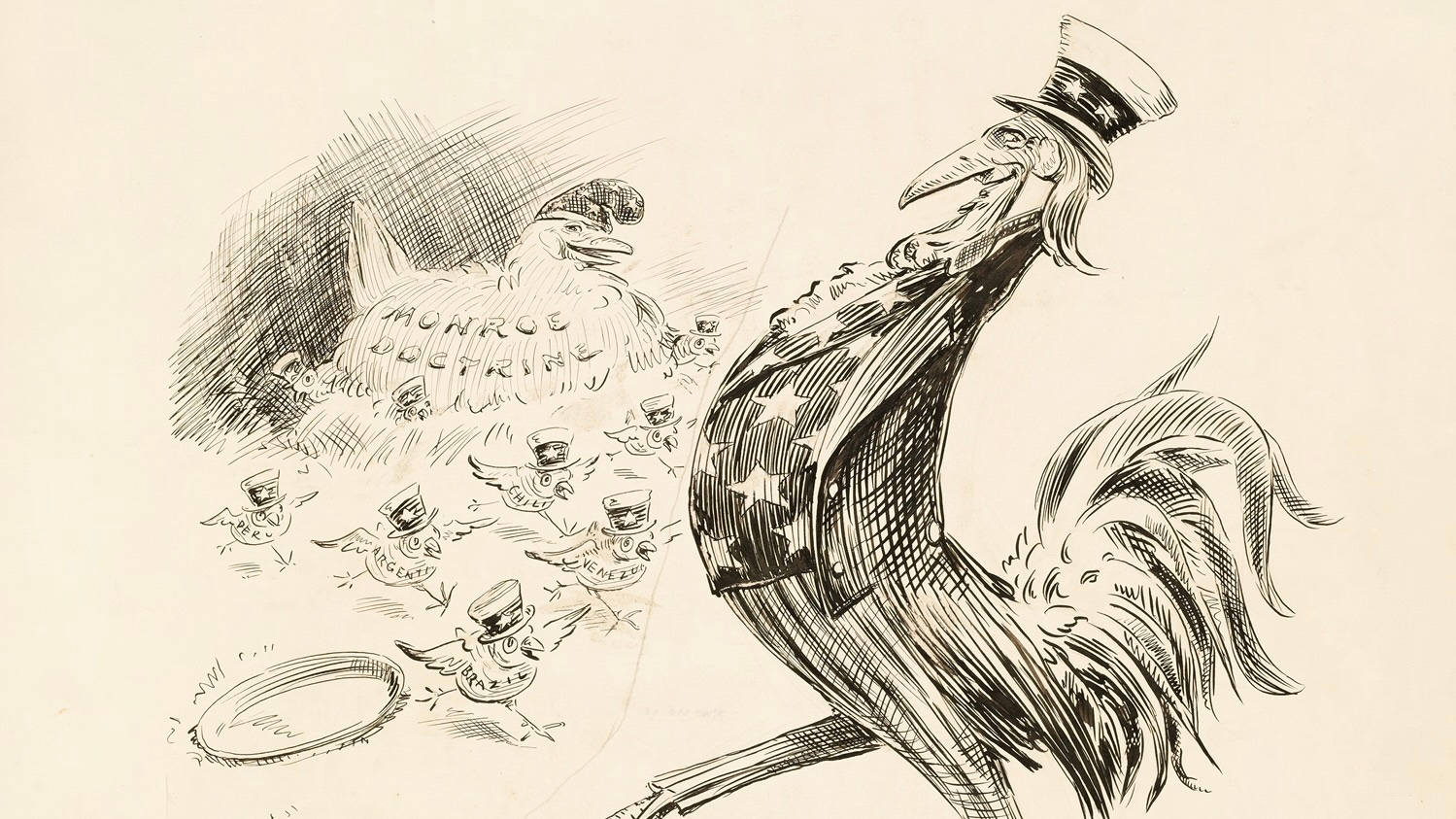
In the post-invasion press conference, Trump alluded to his predecessor President James Monroe’s 1823 doctrine, through which the United States positioned itself against further European colonization of the Americas. “It was very important, but we forgot about it,” Trump said.
The doctrine — and its “corollaries” — go a long way in explaining Trump’s Venezuela policy.
The Monroe Doctrine. From the original text:
With the existing colonies or dependencies of any European power we have not interfered and shall not interfere. But with the Governments who have declared their independence and maintain it, and whose independence we have, on great consideration and on just principles, acknowledged, we could not view any interposition for the purpose of oppressing them, or controlling in any other manner their destiny, by any European power in any other light than as the manifestation of an unfriendly disposition toward the United States.
The Roosevelt Corollary. In 1904, President Theodore Roosevelt added a corollary to the Monroe Doctrine, which provided justification for decades of military interventions in Latin America:
There must be no effort made to remove the mote from our brother’s eye if we refuse to remove the beam from our own. But in extreme cases action may be justifiable and proper. What form the action shall take must depend upon the circumstances of the case; that is, upon the degree of the atrocity and upon our power to remedy it.
The Trump Corollary. Last month, the White House released a new National Security Strategy document, which outlined Trump’s own corollary to the Monroe Doctrine:
After years of neglect, the United States will reassert and enforce the Monroe Doctrine to restore American preeminence in the Western Hemisphere, and to protect our homeland and our access to key geographies throughout the region. We will deny non-Hemispheric competitors the ability to position forces or other threatening capabilities, or to own or control strategically vital assets, in our Hemisphere. This “Trump Corollary” to the Monroe Doctrine is a common-sense and potent restoration of American power and priorities, consistent with American security interests.
“Why Did Europe Obey Monroe?” A useful video from History Matters. Spoiler alert: it partially involves a territorial dispute between Venezuela and the United Kingdom — the same dispute that was resurrected two years ago when Maduro claimed sovereignty over the Essequibo region of Guyana.

From the Crowd
Reactions to Damir Marusic’s essay, “Rupture Without Reformation.”
The Reformation Was More Chaotic Than You Think. Schmendrick writes:
Your commentary is always appreciated. However I don’t think you’ve set up a fair fight.
Mostly, you’re comparing something seen through the clarity of hindsight against something we’re in the middle of and still struggling to make sense of. In the moment, contemporary observers of the Reformation did not have the luxury of a well-edited narrative history to superimpose over all the chaos as you now do, reading scholarly books in a comfy chair. Educated elites in Catholic circles almost certainly found it just as callow, shallow, chaotic, and perverse as you do Trumpistas. Similarly, Future historians will likely have a much cleaner read on Trumpism (or at least their books will be forced to cut out most of the chaff for the sake of readability), once the dust all settles over the coming decades.
Further, religious fights over doctrine are necessarily intellectualized and abstract in a way that political fights don’t necessarily have to be. I think a fairer comparison to Trumpism might be Peronism in Argentina.
Documenting the Wars of Religion. Thomas Brown with another interesting factoid:
… since you mentioned Philip Benedict I can’t resist recommending another book of his, Graphic History: The Wars, Massacres and Troubles of Tortorel and Perrissin (2007) — Tortorel and Perrissin were two French printmakers in exile in Geneva who made a series of images of events from the French Wars of Religion.
Their prints portray the conflict in a dispassionate way that allowed them to appeal to both Catholics and Protestants, nothing like this had been done before.
Benedict’s book is great on the history of portraying events and history of propaganda, and the illustrations are splendid. Preview online here.
See you next week!
Wisdom of Crowds is a platform challenging premises and understanding first principles on politics and culture. Join us!
Dang, and I thought this was just to distract from the Epstein mess. I guess it could be both and??